Precision spraying is becoming a margin story, not a moonshot story
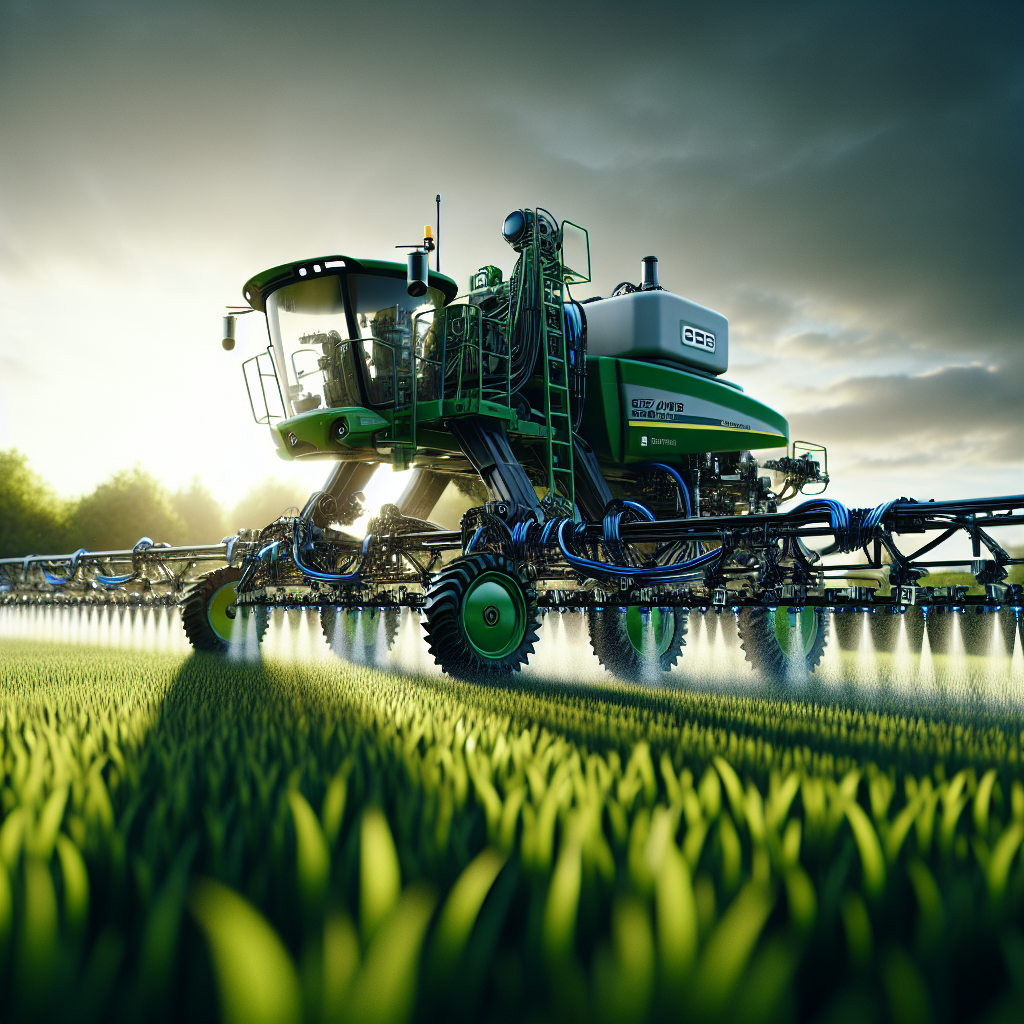
For years, agricultural robotics coverage has centered on fully autonomous tractors and generalized labor automation. That framing misses where the near-term economics are often stronger: targeted input reduction. John Deere’s See & Spray system is a useful case study because it shifts the robotics discussion away from replacing a human operator and toward shrinking one of the most volatile line items in crop production—chemical spend.
That matters because herbicide economics are unusually suited to machine vision. In broadacre farming, growers often spray entire fields because the cost of missing weeds can exceed the cost of over-application. A machine that can distinguish crop from weed in real time changes that tradeoff. If the system performs reliably at field speed, the value proposition is not abstract AI capability; it is fewer gallons applied per acre, lower total chemical cost, and potentially better stewardship in an environment of tighter regulation and weed resistance pressure.
John Deere’s acquisitions and product strategy have made this explicit. The company folded Blue River Technology’s computer vision capabilities into a product path that aims at selective spraying in high-value crops and then broadacre row crops. The strategic significance is larger than one machine attachment. Deere is effectively arguing that in agriculture, the first scalable robotics win may come from precision decision-making mounted on familiar equipment platforms, not from replacing the tractor altogether.
Why this use case is economically cleaner than many farm robotics bets
Agricultural robots often struggle with one of three problems: they are too slow for broadacre operations, they require major workflow redesign, or they solve a labor problem that is seasonal and region-specific rather than universal. Selective spraying avoids much of that friction.
- It fits existing farm operations: The technology is integrated into a pass growers already make.
- It targets a direct cost center: Herbicides are measurable, high-frequency, and increasingly expensive inputs.
- It can preserve machine utilization: Farmers do not need to buy an entirely separate robotic platform for a narrow task.
- It offers agronomic and regulatory upside: Reduced application can support compliance and sustainability claims without changing crop plans.
That is a rare combination in field robotics. Many startup pitches promise eventual system-wide transformation. Selective spraying promises a narrower, easier-to-measure outcome: spend less on chemicals while maintaining weed control quality. Investors and farm operators tend to reward technologies that can be audited at the invoice level.
The strategic importance of Blue River was never just the camera
Blue River Technology became widely known for “see and spray” vision systems, but the more important asset was its operating thesis: machine learning in agriculture becomes valuable when it is attached to an immediate actuation decision. Counting plants is useful. Distinguishing weeds from crops and changing nozzle behavior within milliseconds is commercially stronger.
Deere’s ownership gave that thesis something startups often lack—distribution, installed base, dealer relationships, and financing. In agtech, technical capability alone rarely determines market penetration. Farmers buy into uptime, serviceability, resale logic, and integration with existing machinery ecosystems. Deere can package computer vision as an enhancement to a broader precision agriculture stack that already includes guidance, software, telematics, and application equipment.
This is why the company’s position deserves attention even beyond agriculture. It illustrates a broader robotics pattern: the winners in applied AI are often not the firms with the most novel models, but the firms that can place those models inside a proven equipment and service network.
Where the margin impact can actually show up
The most compelling angle is not labor substitution. A sprayer operator is still in the loop in many deployments. The margin story comes from four operational levers.
1. Lower herbicide usage
This is the headline benefit. In conditions where weeds are patchy rather than uniform, targeted spraying can substantially reduce chemical use compared with blanket application. Savings depend on weed pressure, crop type, field conditions, and the quality of detection, but the core logic is straightforward: fewer weeds sprayed means fewer inputs purchased.
2. Better allocation of premium chemistry
As resistance issues rise, growers increasingly rely on more expensive herbicide programs. Precision application can make premium chemistry more tolerable economically by reducing unnecessary use. That changes the threshold at which higher-performance products make sense.
3. Less waste in volatile input markets
When agricultural input prices spike, technologies that trim unnecessary application gain strategic importance. Precision spraying effectively becomes a hedge against input inflation. That is a more durable thesis than many robotics narratives because it remains relevant even if labor markets loosen.
4. Potential downstream sustainability and compliance value
Reduced chemical load is not just a public relations point. Depending on geography and crop, it may matter for retailer requirements, environmental reporting, and future compliance frameworks. While these benefits can be harder to monetize directly, they strengthen adoption logic for larger operators managing reputational and regulatory risk.
Why autonomous tractors may be more visible—but selective spraying may scale faster
Autonomous tractors make for better headlines because they are easy to visualize as a leap into the future. But the practical barriers are high: safety frameworks, liability questions, edge-case navigation, supervision requirements, and the simple reality that many farms still derive good utilization from human-operated assets.
Selective spraying is less cinematic and arguably more bankable. It rides on equipment categories growers already understand. It improves a known pass. It offers a direct operating expense argument. It does not require the farm to trust a fully driverless machine across every field condition before seeing value.
That difference matters for adoption curves. Technologies that slip into current workflows often spread faster than technologies that require a full behavioral reset. The lesson is not that autonomous tractors will fail. It is that narrow, high-value perception-and-actuation tasks may compound commercially long before end-to-end autonomy becomes routine in broadacre farming.
What could limit the upside
The bullish case should not ignore deployment constraints. Selective spraying is not a guaranteed margin engine in every field or every season.
- Weed density matters: In heavily infested fields, blanket spraying may still be economically rational if nearly everything requires treatment.
- Detection quality is critical: False negatives can be costly if missed weeds reduce yield or increase future pressure.
- Field speed and environmental variability matter: Lighting, dust, crop stage, residue, and weather can all affect machine vision performance.
- Hardware and service costs still need justification: Savings on chemistry must exceed system cost over realistic utilization.
- Regional agronomy is not uniform: What works well in one crop system or weed profile may not transfer cleanly to another.
These constraints are precisely why Deere’s scale matters. Large OEMs can iterate across installed fleets, train dealer networks, and support customers through calibration and service issues that would overwhelm many smaller vendors.
The hidden competitive angle: incumbents can monetize robotics without selling “robots”
One underappreciated aspect of Deere’s strategy is category framing. The company does not need to convince farmers they are buying into speculative robotics. It can position the offering as a practical precision agriculture upgrade. That lowers commercial resistance.
This is important because some of the strongest robotics businesses may emerge inside incumbent equipment categories rather than as standalone robot makers. In these cases, robotics is the enabling layer, not the entire product identity. Investors looking for pure-play robot narratives can miss the fact that the real value accrues to firms that embed autonomy, perception, and decision systems into machines customers already finance, maintain, and trust.
That dynamic also complicates competitive analysis. Deere is not only competing with other selective spraying systems. It is competing on financing terms, dealer service density, software integration, and brand confidence during a narrow planting or spraying window. In agriculture, commercial moat is often built as much in the channel as in the algorithm. For readers evaluating how robotics companies build defensibility, a robotics moat analysis tool is especially relevant to this market structure.
What this says about the next phase of agricultural robotics
The next chapter in agricultural robotics may be less about replacing the farm and more about instrumenting expensive decisions. That favors systems that can sense variability and act on it in real time at production scale. Selective spraying fits that pattern almost perfectly.
It also hints at how value will be distributed across the sector. The winners may not be the companies with the most ambitious autonomy demos. They may be the ones that convert perception into a repeatable economic delta on a single line item—chemical cost, fertilizer usage, crop loss, or machine downtime. Deere’s See & Spray platform is a concrete example of that philosophy at industrial scale.
For growers, the practical question is not whether robotics is coming to the farm. It is which robotic functions are mature enough to improve margins under real field conditions. Right now, precision herbicide application has a stronger answer than many more glamorous autonomy narratives.
For the broader robotics industry, this use case offers a useful correction. The most consequential deployments are not always the most futuristic-looking. Sometimes the breakthrough is a camera, a model, and a nozzle making a better decision at 12 miles per hour.