
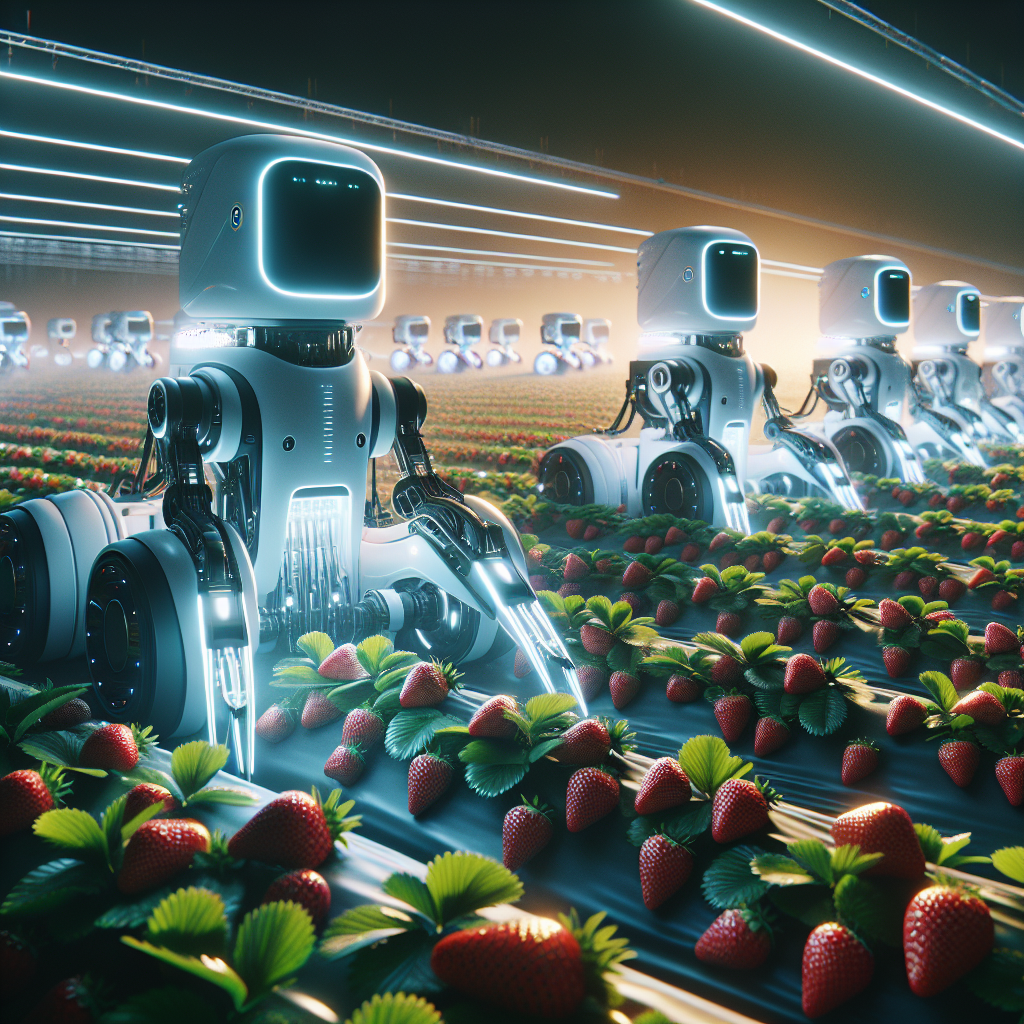
Field robotics has reached the point where crop economics matter more than demo videos
European agricultural robotics is entering a less glamorous phase: fewer spectacle-driven announcements, more scrutiny of whether a machine can survive the margin structure of high-value crops. Strawberries are one of the clearest examples. They are labor-intensive, highly perishable, and difficult to mechanize because fruit grows irregularly, bruises easily, and must be harvested at the right ripeness window. That makes them a better test of commercial viability than broad claims about “AI-powered harvesting.”
One company drawing attention here is Dogtooth Technologies, the UK-based agricultural robotics firm focused on autonomous fruit picking. Its strawberry harvesting systems have been tested with growers facing a structural labor squeeze driven by seasonal worker scarcity, wage inflation, and post-Brexit hiring friction. The deeper story is not that robots can pick strawberries at all. It is whether the numbers work in a crop where growers already operate with tight margins, volatile retail pricing, and weather risk.
This is why strawberry robotics deserves a closer look now. It sits at the intersection of machine vision, soft-touch manipulation, labor market distortion, and farm-level capital budgeting. Unlike generic warehouse automation discussions, the deployment question here is brutally specific: can a grower replace enough unstable seasonal labor, over enough picking days, at low enough fruit-damage rates, to justify the machine?
Why strawberries are such a hard robotics category
Harvesting strawberries is not just a perception problem. It is a systems problem. The robot must identify ripe fruit in cluttered canopies, navigate rows, pick without bruising, and move fast enough to matter during compressed harvest periods. Even then, real-world performance depends on cultivar, planting geometry, lighting conditions, tunnel layout, and fruit presentation.
That complexity explains why many agricultural robotics companies have looked compelling in trial footage but struggled in scaled deployment. A picking robot is only commercially relevant if it can handle the non-ideal conditions farms actually face:
- Variable ripeness within the same row
- Occluded fruit hidden behind leaves or stems
- Mud, humidity, and field maintenance constraints
- Frequent movement between growing areas
- Short seasonal windows that compress asset utilization
In other words, farm robots do not compete against a theoretical labor baseline. They compete against human crews that are flexible, mobile, and capable of making rapid judgment calls in messy environments. That is a much tougher benchmark than most robotics categories admit.
Dogtooth’s real challenge is utilization, not headline capability
Dogtooth Technologies has built automated strawberry picking systems designed to identify and harvest ripe berries in commercial growing environments. The engineering challenge is substantial, but from an investor or farm-operator perspective, the more important issue is machine utilization.
A warehouse robot can often run across long operating windows and standardized workflows. A strawberry picker cannot. Its useful hours are bounded by crop readiness, field conditions, and harvest schedules. That creates an economic paradox common in agricultural robotics: the machine may solve a painful labor problem, yet still struggle to earn an acceptable return because it is not productive enough across the full year.
For growers, the decision is not simply “robot versus worker.” It is a bundle of questions:
- How many pickers can the system realistically displace or supplement?
- What is the fruit-damage rate compared with manual harvesting?
- How much downtime is created by repositioning, maintenance, and supervision?
- Can the robot operate across multiple varieties or farm layouts?
- Is financing available on terms compatible with farm cash flow?
Those questions are why agricultural robotics often moves more slowly than capital markets expect. The constraint is not only technical readiness. It is whether deployment fits the seasonal economics of the customer.
Europe’s labor market makes the case stronger—but not automatically bankable
The argument for strawberry harvesting robots in Europe is straightforward. Seasonal agricultural labor has become harder to secure, more expensive, and less predictable. The UK in particular has faced years of adjustment around migrant labor access, visa structures, and competition for workers. For soft-fruit growers, harvesting delays can destroy value quickly because fruit does not wait for staffing issues to resolve.
That makes automation attractive in principle. But labor shortages alone do not create a bankable robotics market. The robot must outperform the total cost of an increasingly expensive but still highly adaptable human workforce. In many cases, the first practical value proposition is not full labor replacement. It is labor risk reduction.
That distinction matters. A grower may adopt a harvesting robot not because it is cheaper than all human labor on day one, but because it reduces exposure to last-minute worker shortages during peak harvest windows. This shifts the purchasing logic from pure cost takeout to operational resilience. In farming, resilience often deserves a premium because lost harvest volume cannot be recovered later.
For operators trying to frame the economics, a tool like the robot payback utilization simulator is useful precisely because utilization is the variable most likely to make or break an agricultural deployment.
The hidden variable: crop system design
One underappreciated angle in farm robotics is that robots do not just adapt to crops; crops increasingly adapt to robots. In strawberries, this means that the commercial success of autonomous harvesting may depend as much on how farms redesign growing systems as on algorithmic advances.
Growers using tabletop systems, polytunnels, and more standardized row configurations can create a friendlier environment for robotic harvesters. That does not eliminate complexity, but it can reduce the number of edge cases that destroy productivity. The result is a subtle but important shift in market structure: robotics may favor farms willing to redesign production around machine compatibility.
This could have competitive consequences. Larger growers or vertically integrated operators may be better positioned to invest in both robotic equipment and crop-system modifications. Smaller farms, even if they face the same labor pain, may struggle to justify the upfront changes. If that happens, agricultural robotics will not simply automate harvesting. It will reshape who can compete effectively in labor-intensive fruit categories.
Why this matters more than another “AI in agriculture” narrative
Too much robotics coverage treats perception software as the central story. In strawberries, that misses the point. Machine vision matters, but commercialization is more likely to be decided by a narrower set of variables:
- Picking speed per hour
- Successful harvest rate on marketable ripe fruit
- Bruising and quality outcomes
- Uptime across uneven field conditions
- Labor supervision burden
- Seasonal utilization across the asset base
These metrics sound operational because they are. Agricultural robotics is an economics-first category pretending, at times, to be a software story. Investors and growers who ignore that distinction tend to overestimate how quickly adoption will scale.
There is also a procurement reality here. Farms do not buy robots the way distribution centers or automotive plants do. Budgets are tighter, financing structures differ, and returns are affected by weather, disease, and retailer pricing pressure. That means even a technically impressive machine may face slow adoption if its commercial model is too rigid. Leasing, harvesting-as-a-service, and seasonal deployment contracts may matter as much as the robot itself.
Competitive pressure will come from business models, not just better grippers
Dogtooth is not operating in a vacuum. Agricultural robotics remains a fragmented market with companies pursuing harvesting, weeding, spraying, and autonomy layers across different crop systems. The competitive edge in strawberry picking may not come solely from superior robotics hardware. It may come from who can structure deployment in a way farmers can actually absorb.
That could include:
- Shared fleet models across grower cooperatives
- Service contracts tied to harvested output
- Integrated financing with equipment partners
- Systems tailored to specific greenhouse or tunnel formats
- Multi-crop adaptability that expands annual utilization
If a robot can only earn during a narrow strawberry window, its economics remain fragile. If the same platform, operating stack, or mobility base can be extended into adjacent fruit crops or related field tasks, the investment case improves sharply. That is where the next layer of competition is likely to emerge.
What investors should watch over the next 24 months
For investors evaluating agricultural robotics companies, the headline question should not be whether autonomous strawberry harvesting is possible. That threshold has already been crossed in limited conditions. The better question is whether deployments are moving from pilot logic to repeatable commercial logic.
Several indicators matter:
- Paid deployments rather than grant-supported trials
- Evidence of repeat orders from existing growers
- Expansion into standardized farm formats where performance is more predictable
- Commercial models that reduce upfront capital barriers
- Measured quality outcomes that satisfy retailer standards
Just as important is whether customers speak about labor substitution or labor assurance. The latter may sound less dramatic, but it is often the more durable buying trigger. In seasonal agriculture, avoiding missed harvest windows can be more valuable than maximizing theoretical labor savings.
The practical takeaway
Strawberry robots are becoming a revealing test for agricultural automation because they expose the gap between technical success and economic fit. Dogtooth Technologies sits in an important segment of that story, but the broader lesson applies across agtech: deployment success will hinge less on AI marketing and more on whether machines can align with crop calendars, farm layouts, and capital constraints.
That makes strawberry harvesting one of the most useful categories to watch in European robotics. It is difficult enough to be meaningful, commercially urgent enough to matter, and economically constrained enough to separate serious platforms from science-project theater.
The companies that win here will not just prove they can pick fruit. They will prove they understand farming as an operating business, not merely as an environment for robotics demos.