Precision weeding is becoming a harder market to ignore than general-purpose field robotics
John Deere’s push into computer-vision spraying is one of the more important robotics stories in agriculture, not because it looks futuristic, but because the economics are unusually legible. While much of farm robotics still struggles with edge cases, low utilization, and difficult service models, precision spot spraying attacks a narrower problem with measurable chemical savings, an installed dealer network, and a workflow farmers already understand.
The strategic point is simple: a robot does not need to replace a farm worker to create major value. In row crops, reducing non-residual herbicide use by double-digit percentages can justify adoption faster than a multi-purpose autonomous platform that still requires workflow redesign. That is why Deere’s See & Spray system deserves attention as an agricultural robotics deployment story, not merely as another AI feature layered onto farm equipment.
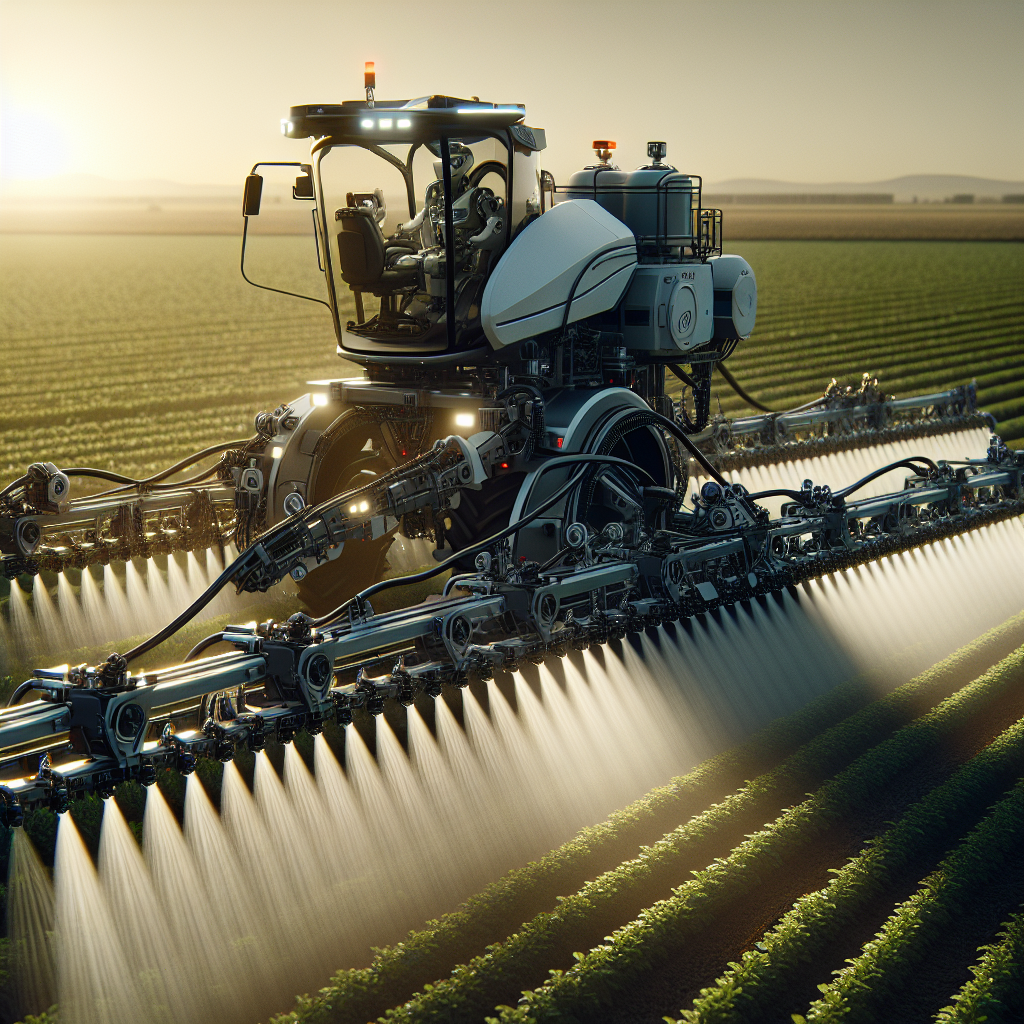
Deere has positioned See & Spray around machine vision that distinguishes crop from weed in real time and then actuates targeted nozzles instead of blanket-spraying an entire field. The result is a robotics stack with three concrete advantages: perception tied to a tightly bounded task, actuation integrated into existing agricultural hardware, and direct savings linked to an input cost farmers already track closely.
Why this use case is stronger than many ag-robot narratives
Agricultural robotics is crowded with ambitious ideas: harvesting robots, autonomous tractors, laser weeders, fruit-picking systems, and mobile platforms meant to perform multiple tasks across the season. Many are technically impressive. Fewer have clean deployment logic. The problem is that agriculture is not a single environment but a shifting set of biological, weather, terrain, and crop-condition variables. The broader the robot’s task list, the more failure points emerge.
Targeted spraying avoids some of that complexity. It works inside a known operation that already exists on large farms. Growers already spray. Equipment financing already exists. Operators already understand uptime requirements, service intervals, and seasonal urgency. Instead of asking a farm to adopt a wholly new robotic labor model, Deere inserts intelligence into a high-value activity where even incremental performance gains matter.
That distinction matters commercially. The agricultural robotics market often treats autonomy as the product. In practice, farmers buy outcomes:
- Lower chemical cost per acre
- Reduced off-target application
- Operational speed during narrow weather windows
- Compatibility with existing field operations
- Reliable service through local dealer support
See & Spray aligns with all five better than many standalone ag robots.
The Deere-Blue River strategy was not about a gadget; it was about controllable unit economics
Deere’s 2017 acquisition of Blue River Technology now looks more strategically disciplined than it first appeared. Blue River brought computer vision and precision application capabilities that mapped directly onto Deere’s core strengths in machinery, distribution, and financing. That matters because many robotics companies underestimate the non-technical layers required for scaled deployment: integration, support, replacement parts, operator training, software updates, and resale confidence.
Deere has a structural advantage here. It is not selling into agriculture as a newcomer trying to prove basic reliability. It is extending an installed ecosystem. For farmers, the decision is not “Should I bet the operation on a startup robot?” but “Does this attachment or system improve the economics of a machine category I already buy from a known supplier?”
This lowers adoption friction in a way that pure-play field robotics companies rarely match.
The hidden lesson for investors and competitors is that agricultural robotics may scale faster when paired with dominant equipment channels than when launched as fully independent robotic platforms. In other words, distribution and service density can matter as much as model accuracy.
The real economic engine: herbicide savings, not automation theater
Public discussion around robotics often defaults to labor substitution, but that framing is less useful here. See & Spray’s strongest economic argument is not eliminating tractor operators. It is reducing expensive inputs while preserving agronomic performance.
In broadacre farming, chemical costs can materially affect margins, especially when commodity prices soften or weather volatility compresses yield expectations. If a system can substantially reduce herbicide volume on eligible acres, the savings are immediate, legible, and repeatable. That is much easier to finance than a speculative promise around future autonomous labor models.
There is also a second-order benefit. Precision application creates a stronger data loop around field conditions, treatment patterns, and agronomic decisions. Over time, that can improve more than a single pass of spraying; it can feed crop management strategies and potentially support variable-rate decisions across the season.
For operators evaluating return on investment, the right question is not simply whether the machine costs more. It is whether the additional capital cost is outweighed by recurring annual savings on chemicals and whether those savings are robust across field conditions. Readers comparing field-level economics can benchmark assumptions with this robot total cost of ownership calculator.
What Deere gets right that many field robotics firms still struggle with
1. A bounded perception problem
General agricultural autonomy is hard because fields are unstructured and variable. See & Spray narrows the problem to identifying weeds or non-crop targets during a spraying operation. That is still technically demanding, but it is more manageable than building a robot that navigates, manipulates, diagnoses crop health, and performs multiple interventions in one platform.
2. Existing power, mobility, and operator context
A major challenge in mobile robotics is not just intelligence but locomotion, energy management, and reliability. Deere’s system rides on equipment classes farmers already operate. That means the robotics layer is not carrying the full burden of creating a new machine category from scratch.
3. Dealer-backed deployment
Robotics in agriculture is brutally seasonal. If a machine fails during a narrow spraying window, the economic penalty can be severe. Deere’s dealer network is therefore not a side note; it is part of the product. Supportability is often the dividing line between prototype excitement and actual acreage at scale.
4. A financing logic farmers understand
Many robotics startups ask customers to embrace unfamiliar pricing models or uncertain payback timelines. Deere benefits from decades of farm equipment purchasing behavior. Bundling advanced spraying capability into a broader machinery relationship makes adoption easier than asking growers to add an entirely separate robotic vendor into an already complex operation.
Why competitors in laser weeding and autonomous field robots should pay attention
The most serious competitive threat to broadacre ag robotics may not come from another startup with a more futuristic machine. It may come from incumbents that target one expensive pain point and solve it inside an established workflow. That creates a difficult environment for standalone robotics firms trying to commercialize more complex systems.
Consider the contrast:
- Laser weeding systems can reduce chemical dependence but often involve slower operating speeds, distinct service demands, and a more visible workflow shift.
- Autonomous field robots promise flexibility but frequently face utilization challenges if they only perform a limited set of seasonal tasks.
- Vision-guided spraying on incumbent machinery keeps throughput high, fits current field operations, and monetizes through input savings farmers can measure per acre.
That does not mean alternative approaches will fail. Specialty crops, organic farming, and high-value produce can support very different economics. But in large-scale row crop systems, the bar is higher. The winning product is not necessarily the most robotic. It is the one that fits the economics and rhythms of the farm.
Deployment constraints still matter, and they should not be ignored
This is not a frictionless market. Precision spraying performance depends on crop type, weed pressure, field conditions, speed, and season timing. Not every acre will produce the same savings profile. Farmers will ask practical questions that determine adoption far more than AI branding:
- How consistent are savings across varying weed densities?
- Does performance degrade at higher operating speeds?
- How often do cameras and nozzles require calibration or maintenance?
- What happens under dust, low light, residue-heavy conditions, or mixed field variability?
- How quickly can a dealer resolve issues during spraying season?
These questions are healthy because they shift the conversation from concept to operating reality. Agricultural robotics has suffered from overpromising in the past. Systems that win will be the ones that perform acceptably under ordinary, imperfect field conditions rather than ideal demos.
Why this may be one of the most investable themes in agricultural robotics
If the investment thesis around robotics is shifting from spectacle to deployment quality, Deere’s precision spraying path looks unusually durable. It combines software differentiation with hardware incumbency, recurring value creation with a familiar procurement channel, and a narrow use case with a very large addressable acreage base.
There is also an important capital-markets implication. Investors often chase broad platform stories because they appear to have larger upside. But field robotics may reward narrower products first, especially where:
- The task is already budgeted
- The value can be measured per acre
- The machine is sold through trusted channels
- The service model already exists
- The technology augments instead of replacing current operations
That profile is less glamorous than a fully autonomous farm robot, but it is often more bankable.
The broader takeaway is that agricultural robotics adoption may not be led by humanoid labor concepts or all-purpose autonomous fleets. It may instead come from embedded systems that make one costly field operation materially more efficient. Precision weeding and spraying fit that pattern better than many categories currently receiving louder media attention.
The bigger industry lesson: robotics scales fastest when it removes a line item, not when it asks for a new philosophy
John Deere’s See & Spray strategy highlights a lesson that extends beyond agriculture. Robotics deployments scale faster when they attach to a visible cost center and preserve familiar workflows. In this case, the relevant line item is herbicide spend, not abstract digital transformation. Farmers do not need to believe in a robotic future to buy into lower cost per acre.
That is what makes this story more than a Deere product update. It is a template for how robotics can move from technical promise to scaled industrial adoption: solve one expensive problem, fit inside the incumbent workflow, support it locally, and make the savings easy to verify.
For agriculture, that may prove more consequential than many headline-grabbing robot launches. Precision spraying is not the flashiest corner of robotics. It may still become one of the most commercially important.