
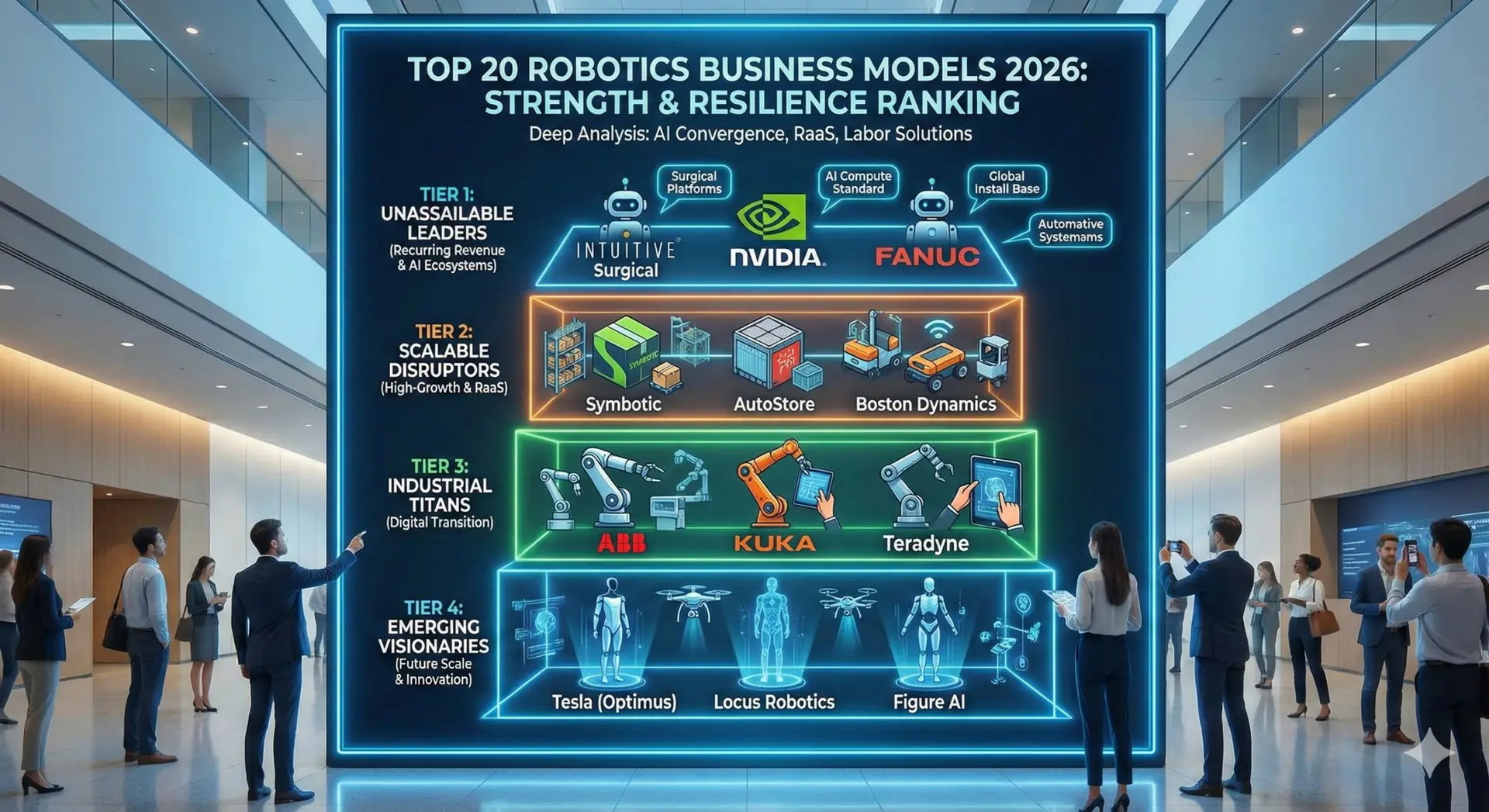
The robotics industry is entering structural acceleration. However, technological excitement does not automatically translate into durable shareholder value. Investors must separate engineering ambition from economic strength.
This expanded ranking evaluates 20 leading robotics companies based on structural business model durability — not demo performance.
Methodology: What Defines Business Model Strength?
Each company is assessed across six structural dimensions:
- Recurring Revenue Exposure
- Installed Base & Switching Costs
- Capital Intensity
- Scalability
- Competitive Moat
- Long-Term Industry Tailwinds
The rankings prioritize economic repeatability over narrative momentum.
Tier I – Structural Compounding Machines
1) Intuitive Surgical
Intuitive remains the gold standard of robotics monetization. Its da Vinci platform generates recurring instrument revenue tied directly to procedure volume. Switching costs are exceptionally high due to surgeon training ecosystems and hospital integration.
Why it ranks #1: High-margin recurring revenue + regulatory moat + global installed base.
2) FANUC
FANUC’s massive installed base across automotive and electronics manufacturing provides durable lifecycle service revenue.
Industrial robotics is cyclical, but factories rarely switch platform providers once standardized.
Core strength: Scale + reliability + embedded automation infrastructure.
3) ABB Robotics
ABB integrates robotics with electrification and digital industrial systems. Cross-divisional synergies strengthen recurring revenue exposure.
Key differentiator: Systems-level integration beyond standalone robotic arms.
4) Yaskawa
Yaskawa’s motion control foundation provides diversified automation exposure beyond robotics hardware alone.
Economic advantage: Servo and drive ecosystem embedded across industrial machinery.
Tier II – Infrastructure Automation Leaders
5) Symbotic
Symbotic’s full-scale warehouse automation creates extremely high switching costs once deployed.
Capital intensity is high, but so are lock-in dynamics.
6) AutoStore
Patented cube-grid architecture provides space-density advantages and defensible IP positioning.
Best suited for urban and high-throughput logistics hubs.
7) Universal Robots
The cobot pioneer benefits from ecosystem effects (UR+) and SME penetration.
Risk: hardware commoditization.
8) KUKA
Engineering-heavy system integration model anchored in European automotive production.
Tier III – Scalable Logistics & Medical Expansion
9) Locus Robotics
Robotics-as-a-Service (RaaS) model improves revenue predictability relative to hardware-only peers.
10) Geek+
China’s most internationally scaled AMR exporter with aggressive deployment capacity.
11) Medtronic (Robotics Division)
Unlike pure-play robotics firms, Medtronic’s diversified portfolio cushions competitive risk.
12) Doosan Robotics
Premium collaborative robotics challenger focused on high-torque safety systems.
Tier IV – High-Risk, High-Upside Humanoid Plays
13) Tesla (Optimus)
If manufacturing scale materializes, Tesla could reset humanoid cost structures globally.
Risk remains execution-heavy.
14) Figure AI
Enterprise-focused humanoid platform with strong venture backing.
15) Agility Robotics
Focused logistics use cases reduce ambiguity compared to broader humanoid visions.
16) Unitree Robotics
Price-disruption strategy powered by Chinese manufacturing velocity.
Tier V – Strategic Optionality & Emerging Cognitive Systems
17) Ocado Technology
Vertical grocery automation model with heavy capital intensity.
18) Neura Robotics
Cognitive robotics positioning could benefit if perception-driven automation becomes standard.
19) XPeng Robotics
Automotive AI leveraged into humanoid robotics; long-duration strategic bet.
20) Boston Dynamics
Technological mobility leader, still refining scalable economic structure.
Cross-Sector Observations
Recurring Revenue Dominates
Medical and infrastructure platforms outperform humanoids in economic durability.
Warehouse Automation is Structurally Justified
E-commerce growth provides measurable ROI pathways.
Humanoids = Optionality Layer
Potential labor transformation, but uncertain monetization timeline.
Final Strategic Conclusion
Robotics is evolving from hardware experimentation into infrastructure-level economic integration.
The strongest platforms today generate recurring revenue embedded in mission-critical workflows. The highest upside remains in humanoid robotics — but requires breakthrough cost compression and sustained operational reliability.
Investors should balance compounding infrastructure leaders with selective exposure to transformative humanoid platforms.