
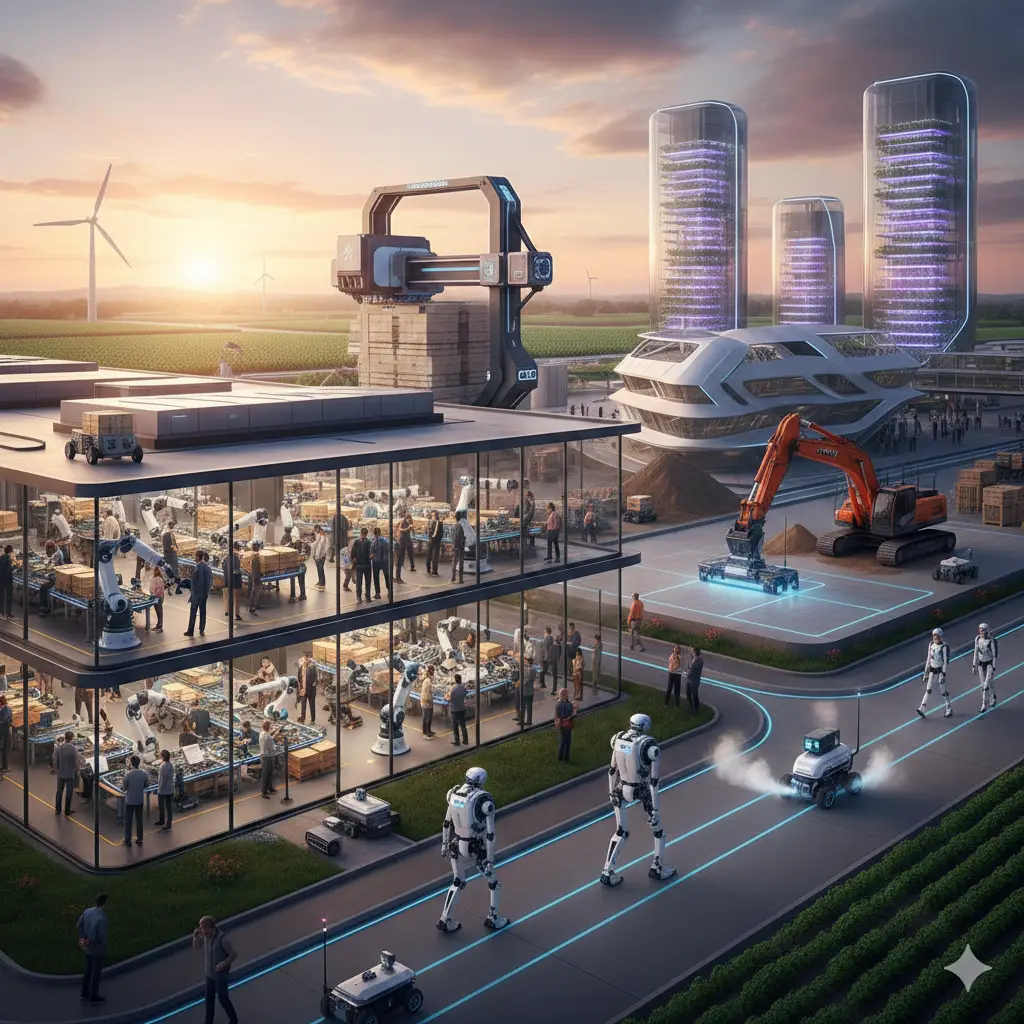
Robotics is entering a capital-intensive, scale-driven decade. The 2010s were about proof of concept. The early 2020s were about funding velocity and AI integration. The second half of this decade will be about something much harder: manufacturing scale, deployment reliability, and sustainable unit economics.
This investor-style overview highlights 15 robotics startups that could materially reshape global industry by 2030. These companies are not ranked by valuation hype, but by their potential to influence labor markets, supply chains, industrial automation density, and capital allocation.
The key investor question: Which of these companies can transition from pilot deployments to repeatable, scalable revenue models?
1) Figure AI (USA)
Figure AI is one of the most capitalized humanoid robotics startups globally. Its strategy focuses on enterprise deployment — particularly factory and warehouse environments — rather than general consumer robotics.
Investment Thesis
- Enterprise-first commercialization model
- Strong institutional backing enabling long development cycles
- Clear focus on industrial labor substitution
Risk: High hardware burn rate and long validation cycles in real industrial environments.
2030 Upside: Multi-site humanoid labor deployment contracts.
2) Agility Robotics (USA)
Agility’s Digit robot targets warehouse logistics — one of the largest addressable markets in physical automation. By focusing on structured environments and repetitive tasks, Agility reduces scope risk.
Investment Thesis
- Narrow use-case discipline improves ROI clarity
- Warehouse labor shortages create structural demand
- Integration into logistics workflows
Risk: Competition from cheaper humanoids or wheeled automation alternatives.
2030 Upside: Large-scale deployment across fulfillment networks.
3) Apptronik (USA)
Apptronik’s Apollo humanoid emphasizes modularity and human-centric design for industrial collaboration. The company positions itself as a scalable humanoid platform for multiple verticals.
Investment Thesis
- Modular platform approach
- Industrial and logistics applications
- Strong robotics heritage from academic research
Risk: Manufacturing complexity scaling beyond prototype phase.
4) 1X Technologies (Norway)
1X focuses on humanoid systems designed for structured indoor environments. Its approach emphasizes safety and compliance in enterprise settings.
Investment Thesis
- Human-safe operational focus
- Targeting repetitive indoor tasks
- Strong AI integration narrative
Risk: Competitive pressure from larger humanoid platforms.
5) Sanctuary AI (Canada)
Sanctuary AI is building general-purpose humanoid robots with a strong emphasis on dexterity and cognitive AI integration.
Investment Thesis
- Advanced manipulation research
- General labor positioning
- Long-term AGI-adjacent narrative
Risk: Complexity and long path to commercial ROI.
6) Unitree Robotics (China)
Unitree has already disrupted quadruped robotics pricing and is expanding aggressively into humanoids.
Investment Thesis
- Volume-driven production model
- Aggressive pricing strategy
- Rapid hardware iteration cycles
Risk: Global regulatory and export constraints.
7) UBTECH Robotics (China)
UBTECH is positioning humanoids for industrial environments and benefits from public market access.
Investment Thesis
- Industrial deployment orientation
- Manufacturing ambition
- Capital market exposure
Risk: Transition from project-based revenue to repeatable industrial contracts.
8) ANYbotics (Switzerland)
ANYbotics focuses on autonomous inspection robots for industrial environments such as energy and heavy manufacturing.
Investment Thesis
- Clear ROI use-case (inspection automation)
- Strong integration with asset management systems
- Expansion potential in energy infrastructure
Risk: Limited TAM relative to humanoid general labor ambitions.
9) Covariant (USA)
Covariant develops AI-powered robotic picking systems for warehouses, focusing on vision-based automation.
Investment Thesis
- Software-heavy robotics model
- Warehouse automation growth tailwinds
- Scalable AI training loops
Risk: Integration complexity and competition from large automation incumbents.
10) Zipline (USA)
Zipline is redefining logistics through autonomous aerial delivery systems, particularly in healthcare supply chains.
Investment Thesis
- Proven real-world deployments
- Healthcare logistics niche
- Regulatory-first operational model
Risk: Airspace regulatory scaling across markets.
11) Nuro (USA)
Nuro develops autonomous delivery vehicles optimized for last-mile logistics.
Investment Thesis
- Consumer logistics automation
- Partnership-driven expansion
- Autonomy software leverage
Risk: Regulatory hurdles and capital intensity.
12) Carbon Robotics (USA)
Carbon Robotics builds AI-powered agricultural robots that eliminate weeds using laser technology.
Investment Thesis
- Clear farm-level ROI
- Labor substitution in agriculture
- Precision agriculture tailwinds
Risk: Seasonal demand cycles and hardware durability.
13) Dexterity AI (USA)
Dexterity AI develops industrial robots capable of complex manipulation tasks using AI control systems.
Investment Thesis
- High-dexterity automation niche
- Software-driven differentiation
- Industrial integration focus
Risk: Scaling hardware deployment.
14) Gecko Robotics (USA)
Gecko Robotics specializes in infrastructure inspection robots for energy and industrial assets.
Investment Thesis
- Infrastructure resilience trend
- High-margin inspection analytics
- Government and industrial contracts
Risk: Concentration in heavy industry verticals.
15) Fourier Intelligence (China/Singapore)
Fourier Intelligence develops humanoid and rehabilitation robotics platforms, bridging healthcare and industrial robotics.
Investment Thesis
- Dual-use healthcare + humanoid applications
- Strong mechatronics foundation
- Expansion into embodied AI platforms
Risk: Market segmentation between medical and industrial robotics.
Cross-Cutting Investment Themes Toward 2030
1) Manufacturing Scale Will Separate Winners from Visionaries
Prototype excellence is no longer sufficient. Companies must demonstrate supply chain control, cost-down capability, and field service scalability.
2) Recurring Revenue Is the Holy Grail
Robotics models that combine hardware with recurring software, analytics, or service revenue are structurally more attractive to capital markets.
3) Labor Economics Will Drive Adoption
Demographic shifts, reshoring, and wage pressure create structural tailwinds for automation across logistics, manufacturing, agriculture, and healthcare.
4) China vs US Industrial Acceleration
Hardware iteration speed from China combined with AI/software depth from US ecosystems will define global competitive dynamics.
Conclusion
By 2030, robotics will likely transition from experimental deployments to embedded infrastructure across global industry. The startups listed above represent the highest probability candidates to shape that transformation — not because of hype, but because they target large addressable markets with scalable automation narratives.
For investors and industry operators, the core evaluation framework remains simple:
- Can the company scale manufacturing?
- Can it integrate into real workflows?
- Can it generate recurring revenue?
- Can it survive long hardware burn cycles?
The next five years will determine which of these robotics startups become foundational platforms — and which remain ambitious prototypes.