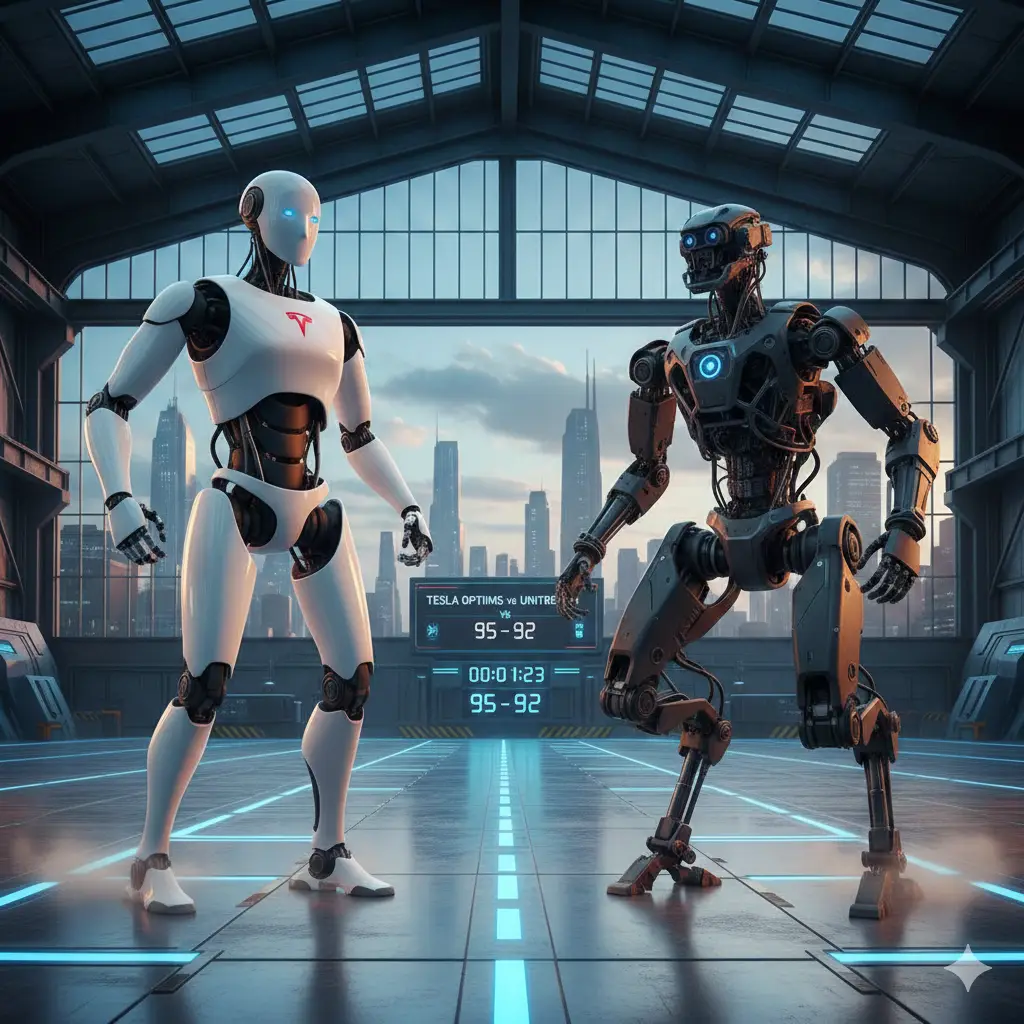
Humanoid robotics is splitting into two tracks: “manufacturing-first at scale” (Tesla) and “sell-now to developers/research” (Unitree). Optimus and H1 embody that divide. Below is a practical, spec-aware comparison of what each platform is optimizing for—and what that means if you’re evaluating capability, timelines, and real-world usefulness.
Quick comparison
| Category | Tesla Optimus | Unitree H1 / H1-2 |
|---|---|---|
| Primary goal | High-volume, low-cost “general labor” for Tesla factories first; broader markets later | Commercially available humanoid platform for labs, developers, R&D and demos |
| Availability | Not broadly commercial; Tesla has indicated internal deployment first (2025) and scaling later | Buyable today via Unitree’s channels (marketed “price below $90k” / list pricing shown in shop) |
| Locomotion headline | Steady walking and factory-safe movement focus (public demos show improving gait/control) | Speed-focused: Unitree markets high-power performance; widely reported ~3.3 m/s “record” run |
| Hands / manipulation | Strong emphasis; Gen 2 showed delicate handling (e.g., egg demo) and ongoing hand upgrades | Manipulation improving, but brand positioning is still more mobility/actuation-forward than dexterity-first |
| Dev ecosystem | Closed ecosystem; advantage is Tesla AI stack, manufacturing, and data flywheel | Developer-facing SDK/docs plus ROS2-related tooling in the open ecosystem |
| Why it matters | If Tesla hits scale, Optimus could become the “Model 3 moment” for humanoids | If you need a full-size humanoid now, H1 is one of the most accessible options |
1) Design philosophy: scale vs. sell-now
Tesla Optimus is built like a product that’s meant to be mass-manufactured—eventually. Tesla’s messaging repeatedly frames Optimus as a pathway to abundant labor, with internal factory use as the proving ground before broader commercialization. The “secret sauce” is not a single spec; it’s Tesla’s integration of manufacturing, supply chain, and AI compute at consumer scale.
Unitree H1 feels like the opposite: a performance-forward humanoid you can purchase and integrate into your research or development pipeline today. Unitree’s public materials emphasize powertrain performance, torque density, and mobility—traits that matter a lot in labs working on locomotion, whole-body control, and embodied AI.
2) Mobility & whole-body control
Unitree has been highly intentional about owning the “fast humanoid” narrative. Its official product page highlights stability, flexibility, and high-power performance, and third-party coverage frequently centers on ~3.3 m/s running demonstrations (often described as a record). In practice, this means H1 is a strong choice when your work requires dynamic walking/running, fast disturbance recovery, and experimenting with aggressive gaits.
Optimus, at least publicly, looks more conservative: smoother walking, safer motions, and task-oriented movement that resembles what you’d want on a factory floor. That may look “less exciting” than sprint clips, but it aligns with Tesla’s stated goal: repetitive, useful work that can run all day without breaking itself—or your workplace.
3) Hands and manipulation: where Optimus aims to win
Humanoids don’t become economically valuable because they can run fast; they become valuable because they can reliably manipulate the world: pick, place, orient, fasten, sort, and interact with human tools and environments.
Tesla has consistently showcased manipulation progress (for example, the widely covered “handle an egg without cracking it” demo) and has publicly discussed ongoing hand upgrades. Manipulation is the long pole in the tent for general-purpose humanoids—so Tesla’s focus here is strategically coherent.
Unitree is improving quickly as well, but the H1 brand story remains more rooted in mobility and high-output actuation. If your top KPI is dexterity and fine motor tasks, Optimus is the one that’s “trying to be the hands company.” If your KPI is whole-body motion research and deployment-ready hardware, H1 often looks like the faster path.
4) Sensors & perception: practical differences
Unitree’s H1 marketing and documentation emphasize 360° depth sensing and commonly referenced LiDAR + depth camera configurations. That’s a classic robotics stack: predictable, developer-friendly, and well-aligned with mapping/localization research and lab integration.
Tesla’s public Optimus details are less “here’s the sensor SKU list” and more “it inherits Tesla’s AI approach.” In other words: fewer explicit off-the-shelf disclosures, more dependence on Tesla’s internal compute/vision pipeline and manufacturing-grade integration.
5) Software & developer experience
If you want to build on a humanoid like a robotics engineer—iterate quickly, integrate with ROS, connect to your own autonomy stack—Unitree’s ecosystem is simply closer to that workflow. Unitree provides developer guides and maintains open-source repositories related to its SDK/ROS2 tooling.
Tesla, by contrast, is building an appliance-like platform where the “developer” is Tesla itself (at least for now). That can be a disadvantage for external researchers, but it can be a huge advantage if Tesla reaches scale: the product becomes standardized, cheap, and supported like a consumer device.
6) Economics: price, scale, and the timeline gap
Unitree’s pitch is straightforward: pay a (high) five-figure amount and get a full-size humanoid platform now. Unitree’s own materials and shop listings frame H1 pricing around the ~$90k tier (exact commercial terms can vary by region, duties, configuration, and support).
Tesla’s pitch is future-cost disruption: the idea that Optimus could eventually be produced in enormous quantities at dramatically lower per-unit cost than typical research humanoids. Whether and when that happens is the key uncertainty. Even Tesla-friendly reporting continues to frame availability as staged—internal use first, then external scale later.
Who should choose what?
- Choose Unitree H1 if… you need a full-size humanoid platform now for R&D, demos, locomotion research, or embodied AI experiments, and you want a developer-oriented stack with robotics ecosystem compatibility.
- Watch (or wait for) Tesla Optimus if… your thesis is that the winning humanoid will be the one that reaches manufacturing scale and cost collapse, and you care most about manipulation + industrial deployment rather than near-term lab access.
The bottom line
Optimus vs H1 isn’t just a spec fight—it’s a bet on how humanoids become “real products.” Unitree is racing to put capable hardware in the hands of builders today. Tesla is aiming to do what it did in EVs: use vertical integration and manufacturing scale to make a previously expensive category mainstream. If you’re buying in 2026, H1 is the pragmatic option. If you’re forecasting 2028–2035, Optimus is the existential wildcard.
Sources
- Unitree official H1 page (spec highlights)
- Unitree shop listing (pricing framing / sales channel)
- Unitree H1 developer documentation
- Unitree ROS2-related repository (developer ecosystem)
- Ars Technica (Optimus Gen 2 demo coverage)
- Reuters (Tesla timeline statements for Optimus internal use and scaling)
- Tesla Investor Relations: Q4 & FY 2025 Update (mentions autonomous robots investment)
- The Verge (AI Day 2022 Optimus technical points)