
A practical, numbers-first breakdown of BOM, manufacturing, and the hidden costs that separate a demo robot from a deployable product.
“How much does it cost to build a humanoid robot?” sounds like a simple question, but it depends on what you mean by build. Are we talking about the raw hardware parts (bill of materials, or BOM)? A single prototype? A small production run? Or a commercially supported robot that can run for thousands of hours with safety, service, and software updates?
The short answer: today’s humanoid hardware BOM is often measured in the tens of thousands of dollars for high-capability robots, but scale and design optimization could push BOM dramatically lower over time. Multiple research notes and teardowns point to costs being concentrated in actuators and hands, with meaningful declines expected as volumes rise. (See sources in the footer.)
Start with definitions: BOM vs “Total Build Cost”
1) Bill of Materials (BOM)
The BOM is the cost of the physical components in one robot: actuators, sensors, compute, battery, structure, wiring, fasteners, etc. It typically excludes software, most R&D, and usually excludes overhead and support.
2) Unit cost to manufacture
This adds assembly labor, factory overhead, yield/scrap, calibration, test time, packaging, and logistics from the factory.
3) Total cost to commercialize
This is the real-world number: software development, safety engineering, certifications, quality systems, warranty reserves, service operations, spare parts, documentation, training, and continuous updates.
What do credible sources say about humanoid BOM today?
Public numbers vary because most companies don’t publish BOMs. But there are a few recurring references:
- Morgan Stanley estimate (summarized in a University of Cincinnati OLLI handout): Tesla Optimus Gen-2 current BOM estimated at $50k–$60k (excluding software). This is a “current state” estimate, not a mature mass-production cost.
- Bank of America Global Research (Apr 2025): projects BOM could fall to roughly $13k–$17k per unit by around 2030–2035 as scale and component designs improve.
- UBS (May 2025), reproducing BoA research: highlights cost concentration in core motion components—actuators and hands dominate the BOM share.
- McKinsey (Oct 2025): notes BOM costs are concentrated in a few key areas and discusses how teardown analyses inform these cost drivers.
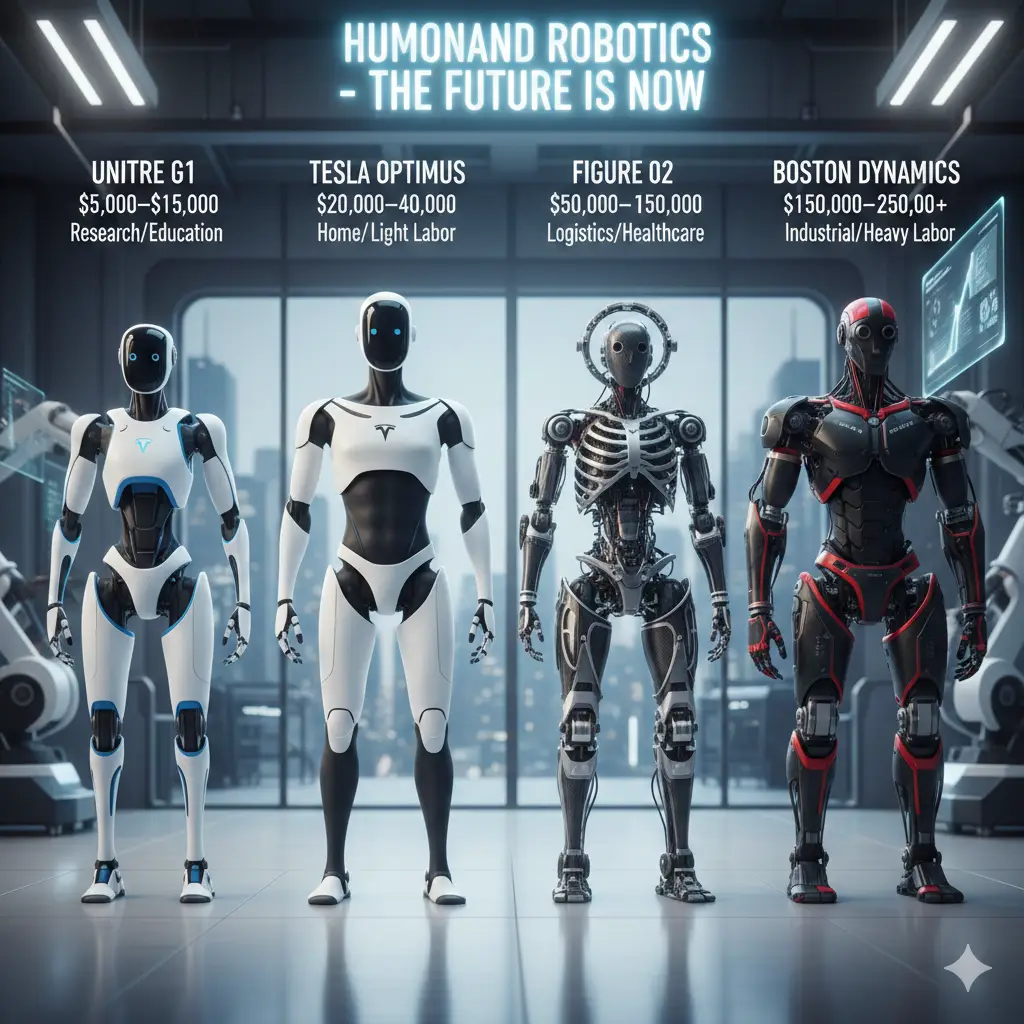
Meanwhile, retail pricing signals are getting more aggressive: Reuters reported Unitree’s R1 at 39,900 yuan (~US$5.6k at the time), a dramatic drop from prior models—suggesting rapid cost-down progress (at least for certain configurations).
Where the money goes: a practical BOM breakdown
Across major analyses, one message repeats: actuation is the cost center—the motors/gearboxes/linear actuators that create humanlike motion—followed by hands and the mechanical structure. UBS, citing BoA, illustrates large BOM shares in actuators and dexterous hands.
A reasonable “today” BOM split for a capable humanoid (not a toy, not a pure research skeleton) often looks like this:
| Subsystem | Typical share of BOM (rule of thumb) | What drives cost |
|---|---|---|
| Actuators (rotary + linear) | ~40%–55% | Torque density, precision, thermal management, gearbox quality, manufacturing yield |
| Hands / end effectors | ~10%–25% | DoF, force sensing, durability, tactile sensing, control complexity |
| Structure & mechanics | ~10%–20% | Machined parts vs cast/formed, lightweight materials, tolerances |
| Sensors | ~5%–15% | Cameras, depth, LiDAR, IMUs, force/torque sensors; redundancy requirements |
| Compute & electronics | ~5%–15% | SoC/GPU class, safety MCU, motor drivers, wiring harness complexity |
| Battery & power system | ~5%–12% | Energy density, safety systems, battery management, pack engineering |
The key takeaway is that even if cameras and compute get cheaper (as consumer electronics do), a humanoid still needs dozens of high-performance actuators and a robust mechanical system. That’s why cost-down is fundamentally about actuators, hands, and manufacturing scale.
A realistic cost range (2026): prototype vs production
Below is a practical “range map” you can use when thinking about costs. These are not guarantees—just grounded categories aligned with public research notes and pricing signals.
| Stage | What it includes | Typical BOM / unit economics (rough) |
|---|---|---|
| One-off prototype | Custom parts, low yields, expensive machining, engineering time | $80k–$250k+ (can be much higher with bespoke components) |
| Small batch (dozens–hundreds) | Some standardization, still limited supplier leverage | $40k–$120k BOM (often cited band for capable systems) |
| Early commercial (hundreds–thousands) | Design for manufacturability, better yields, vendor negotiation | $25k–$60k BOM (e.g., MS/Optimus estimate as “current” reference point) |
| Scaled production (10k+) | Vertical integration, standardized modules, high-volume actuation | $13k–$30k (BofA sees sub-$17k plausible by ~2030–2035 at scale) |
| Ultra-low-cost disruption | Highly optimized config, limited capability/support, aggressive margin | Retail signals as low as ~$5k–$10k have appeared (e.g., Unitree R1 pricing reported by Reuters), but “all-in commercial” cost can still be higher |
Note the difference between a low retail price headline and what enterprise customers ultimately care about: total cost of ownership (uptime, maintenance, service, spares, software updates, safety compliance).
The hidden costs: what BOM doesn’t tell you
1) Engineering & R&D (non-recurring engineering)
Humanoids are complex mechatronic systems. R&D includes actuator design, thermal engineering, reliability testing, safety systems, and—crucially—software and AI stacks. A “cheap BOM” does not mean a cheap product if the company must subsidize years of development.
2) Safety and certification
Once a robot shares space with humans, safety requirements become a gating factor. Enterprise deployments may require rigorous validation, documentation, and certification work that adds cost and time.
3) Service network + warranty reserve
If a company ships 1,000 robots and each needs parts, calibration, or field service, the support structure becomes a meaningful cost center. Mature robotics companies often plan warranty reserves into pricing.
4) Integration and deployment
Even if the robot is “general purpose,” real jobs require integration: mapping sites, teaching workflows, configuring safety zones, connecting to MES/WMS systems, and training staff. In many industrial automation projects, integration costs can rival hardware costs.
What will make humanoids cheaper?
The most credible cost-down levers show up repeatedly in the literature:
- Vertical integration: in-house actuators, motor drivers, key sensors
- Standardization: modular joint units reused across limbs and models
- Design for manufacturability: fewer parts, easier assembly, higher yields
- Scale: volumes large enough to reshape supplier pricing and amortize tooling
- Hands simplification: fewer DoF or task-specific end effectors when appropriate
If you believe the “inevitable” argument for humanoids, you’re really betting on a cost curve: once volumes rise, the actuator and manufacturing ecosystem matures, and BOM targets like those projected by BofA become achievable.
Bottom line
In 2026, a capable humanoid robot can still cost tens of thousands of dollars in hardware BOM, with total commercialization costs pushing well beyond that. But the direction is clear: cost is being compressed aggressively—especially in China—and multiple research sources expect continued BOM declines as scale emerges.
The most important mental model is this: humanoids aren’t getting cheaper because they’re becoming simpler; they’re getting cheaper because the industry is learning how to manufacture complex, actuator-heavy machines at scale.
Sources
- Reuters (Jul 25, 2025): Unitree R1 pricing at 39,900 yuan and comparison to prior model. Source
- McKinsey (Oct 15, 2025): Discussion of humanoid robot cost drivers and BOM concentration (teardown-based insights). Source
- Bank of America Global Research (Apr 29, 2025) PDF: BOM cost forecast of $13k–$17k by ~2030–2035 (scale-driven declines). Source
- UBS Asset Management (May 28, 2025): BOM share chart citing BoA research; highlights actuator + hand cost concentration. Source
- University of Cincinnati OLLI handout (Spring 2025) PDF summarizing a Morgan Stanley Optimus Gen-2 BOM estimate ($50k–$60k, excluding software). Source
About RoboChronicle
RoboChronicle tracks the global robotics revolution—humanoids, industrial automation, and the companies shaping embodied intelligence.